
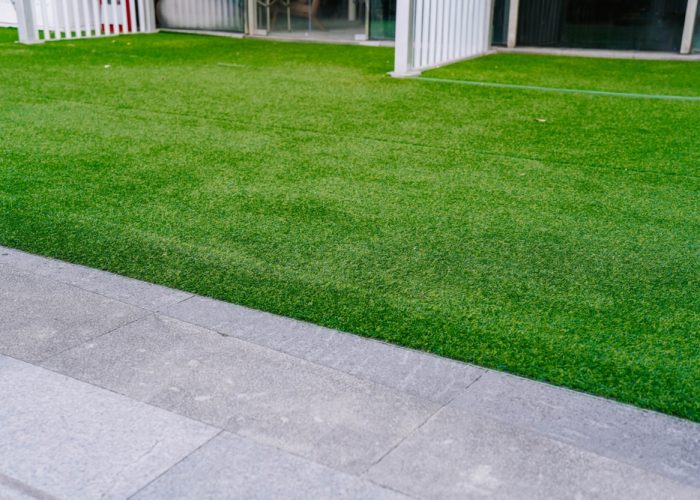
Artificial,Grass,Lawn,Turf,In,The,Front,Yard,Of,A

Moisture Management: Choosing the Right Seam Tape for Pet Runs vs. Patios

It’s Not Just About Holding the Grass Together

When buying artificial turf supplies, most people focus on the face weight of the grass or the color of the thatch. The seam tape is usually an afterthought—just something to hold the pieces together.

But the seam tape plays a critical role in how your installation handles water (and other liquids).

Polysols offers two distinct versions of our 12-inch commercial seam tape: With Moisture Barrier and Without Moisture Barrier. Choosing the wrong one can lead to drainage nightmares or damaged subfloors. Here is how to pick the winner for your specific job.

Scenario A: The Pet Run or Putting Green (Drainage is King)

If you are installing turf over a crushed aggregate base (gravel/road base) for a dog run, playground, or backyard putting green, drainage is your number one priority.

The Risk: If you use a tape with a solid plastic backing (Moisture Barrier) in a pet run, you create a 12-inch wide dam running down the middle of your lawn. When it rains—or when the dog does its business—that liquid hits the tape and sits there. It cannot drain through to the aggregate base.

  • Result: Puddles, mold, and persistent pet odors that are impossible to wash away.

The Solution: Polysols Tape WITHOUT Moisture Barrier This version features a permeable, non-woven backing. It holds the glue perfectly but allows water and urine to pass through the seam and drain into the sub-base naturally.

Scenario B: The Rooftop, Deck, or Indoor Gym (Protection is King)

If you are gluing turf down over a solid surface—like a wooden deck, a concrete patio, or an indoor gym floor—your priority shifts from drainage to protection.

The Risk: If you use a permeable tape on a wooden deck, the moisture (and the liquid glue itself!) will seep through the tape and sit on the wood.

  • Result: The glue bonds permanently to your expensive deck (making future removal a nightmare), and trapped water rots the wood from the top down.

The Solution: Polysols Tape WITH Moisture Barrier This version features a solid poly-backing that is completely impermeable.

  1. Stops Glue Bleed: It prevents the liquid adhesive from seeping through and staining the concrete or wood below.
  2. Protects Subfloor: It acts as a shield, ensuring that any moisture sitting in the turf doesn’t saturate the surface underneath.

Summary Cheat Sheet

ApplicationRecommended TapeWhy?
Backyard LawnWithout BarrierMaximize drainage into soil/aggregate.
Dog RunWithout BarrierPrevent odor; allow urine to drain.
Concrete PatioWith BarrierPrevent glue stains; easier future removal.
Wooden DeckWith BarrierProtect wood from rot/moisture.
Indoor GymWith BarrierPrevent glue from ruining the subfloor.

Don’t let a $80 roll of tape ruin a $5,000 project. Match the tape to the terrain.

Shop Polysols Turf Seam Tape Variants

Winter Proofing Your Jobsite: Protecting Floors from Salt, Mud, and Snow

A single winter storm can track enough rock salt and melting snow onto your jobsite to ruin a newly finished hardwood floor in an afternoon. But the danger isn't just to the wood—it's to your crew. Here is why switching to waterproof, anti-slip protection is the cheapest insurance policy you can buy this winter.

Distributor vs. Manufacturer Direct: Where is Your Margin Going?

You fight for every percentage point of margin on your bids. So why are you handing 30% of it right back to the local distributor for consumables like floor protection? In this guide, we break down the supply chain math and show how buying direct from Polysols doesn't just save you money—it guarantees you have the product when you need it.

Seam Tape vs. Glue-Down: Which Method Prevents “Seam Popping”?

The phone rings six months after a turf install. It’s the client. 'There’s a gap in the grass.' Seam popping is the number one cause of callbacks in the synthetic turf industry. It eats your profit and kills your reputation. Here is why the 'old school' glue methods are failing and why carrier tapes are the industry standard for longevity.

Vapor Barriers vs. Acoustical Underlayment: Do You Need Both?

It is the most common question we hear from installers: 'I bought the underlayment for the sound rating, but do I still need to roll out that plastic sheet underneath it?' If you are installing over concrete, the answer is almost always yes. But that doesn't mean you need to buy—and install—two separate products.